June 30, 2026 · 4 min read
AI-Assisted Editing: Where We Use It and Where We Don't
We use AI in the edit room every week, and we keep it out of the cut on purpose. Here is where the line sits for us — the mechanical work it earns, the decisions it never touches, and what we owe the footage and the people behind it.
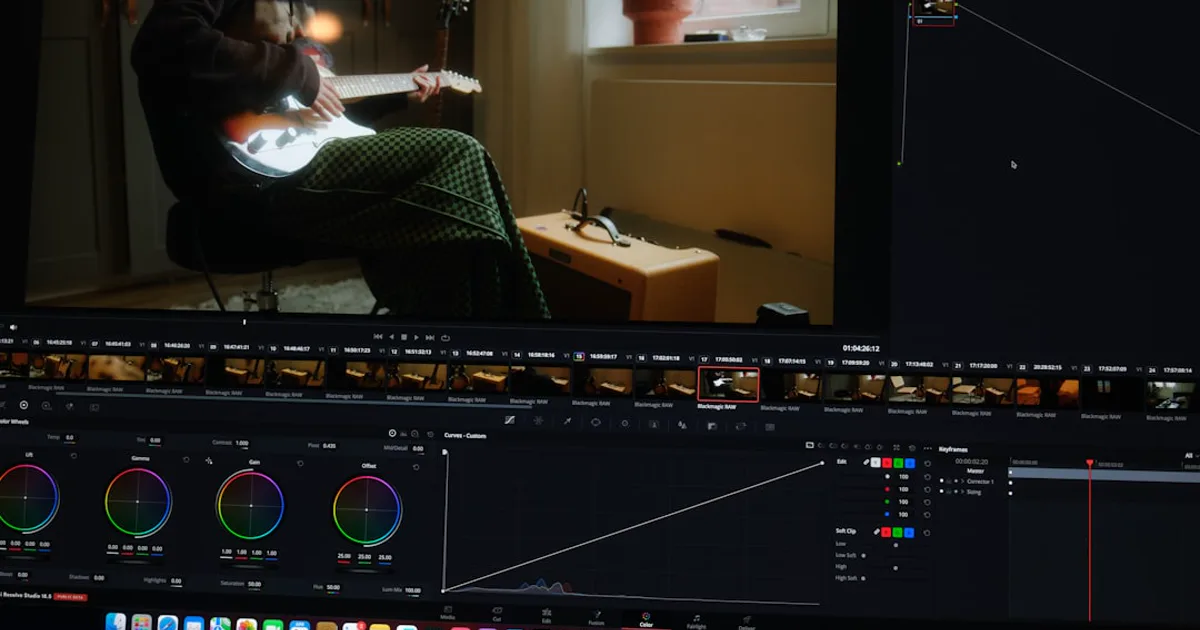
The question in the edit room was never whether we use AI. We do, most weeks. What matters is which tasks we hand it and which ones we never will, and that line has turned out to be sharper, and more useful, than the noise around it suggests. We aren't holding the tools at arm's length out of fear. We use them where they earn their keep, and keep them out of the places where they'd quietly make a worse film. This is a working note on where that line sits for us — written so we could defend every sentence to another filmmaker over coffee.
Where it earns a seat in the edit room
The honest answer is that AI is very good at the work nobody got into editing to do. Transcription and speech-to-text, syncing dailies, logging, searching a week of footage by what someone actually said on camera — that used to eat an assistant's week, and now it runs while we get coffee. None of this is exotic. It already ships inside the software on our timeline: Avid's ScriptSync and PhraseFind, the audio-to-text in Blackmagic's Resolve neural engine. We turned it on and stopped thinking about it, which is the highest compliment a tool gets here.
What's striking is that the people building these tools draw the same line we do. At IBC, Avid's CEO described AI as "a co-pilot, to help a creative person do the work they are doing" — useful for a rough cut on something formulaic like a sports highlight, but, in his words, "it's not going to edit it for you," and explicitly not for narrative features (The Hollywood Reporter). That maps to how we actually work. The tool surfaces and organizes; we decide. Object removal to fix a continuity slip, motion tracking, a clean background plate — real time savers, all of them, but scaffolding, not the building. As one survey of the shift put it, AI handles what is measurable and repetitive while humans handle what requires interpretation (Variety). We haven't found a reason to argue with that.
Where we keep it out of the cut
The cut itself is the opposite of repeatable. Rhythm, a performance landing or not landing, the exact frame where a scene turns — none of that is a task you can describe to a model, because we can't fully describe it to each other. We've watched a festival cut fall flat in a room and traced the fix back to a person watching it cold, not to a smarter tool. We wrote about a submission that didn't land for exactly this reason: the problem was a judgment call, and judgment is the part we're paid for.
Nonfiction sharpens the line further, because there the stakes are trust. The documentary editors arguing this out in public keep returning to the same point — the form depends on the audience believing what they're watching is real, and undisclosed manipulation quietly spends that trust. The reference case everyone names is the synthesized Anthony Bourdain voice in "Roadrunner," generated and used without clear disclosure (Variety). Our rule comes out of that: nothing synthesized stands in for something real without the viewer knowing. We'll use AI to find the take. We won't use it to fake one.
What we owe the footage and the people
Two things sit underneath the line and hold it up. The first is provenance. Where a model came from is not a footnote — it decides whether we're comfortable running a client's footage through it at all. The industry's better instincts already point here, toward content credentials, "do not train" flags, and the ability to choose ethically sourced models (The Hollywood Reporter). If we can't account for how a tool was trained, it doesn't touch the material.
The second is plainer. Labor is the largest line item on most productions, which makes AI the easiest cost to cut — and the one that lands first on assistant editors, transcriptionists, and the people early in their careers. The documentarians making this case put it simply: a funded production carries a responsibility to hire humans (Variety). We use AI to give the people in our room better hours, not to remove the room. That's a choice, and we'd rather make it on purpose than have it made for us by a budget line.
So the line holds where it started: the tool earns the boring work, and we keep the call. It's the same discipline we bring to the way we run a spotting session — name precisely what the tool is good at, then protect the room where a person has to decide. Across the film, the music, and the sound, the part that makes the work ours is the judgment. That's the one thing we're not handing over.
Keep reading
More from the journal →